
When Your Mind Won’t Switch Off: A Practical Guide to Clocking Out
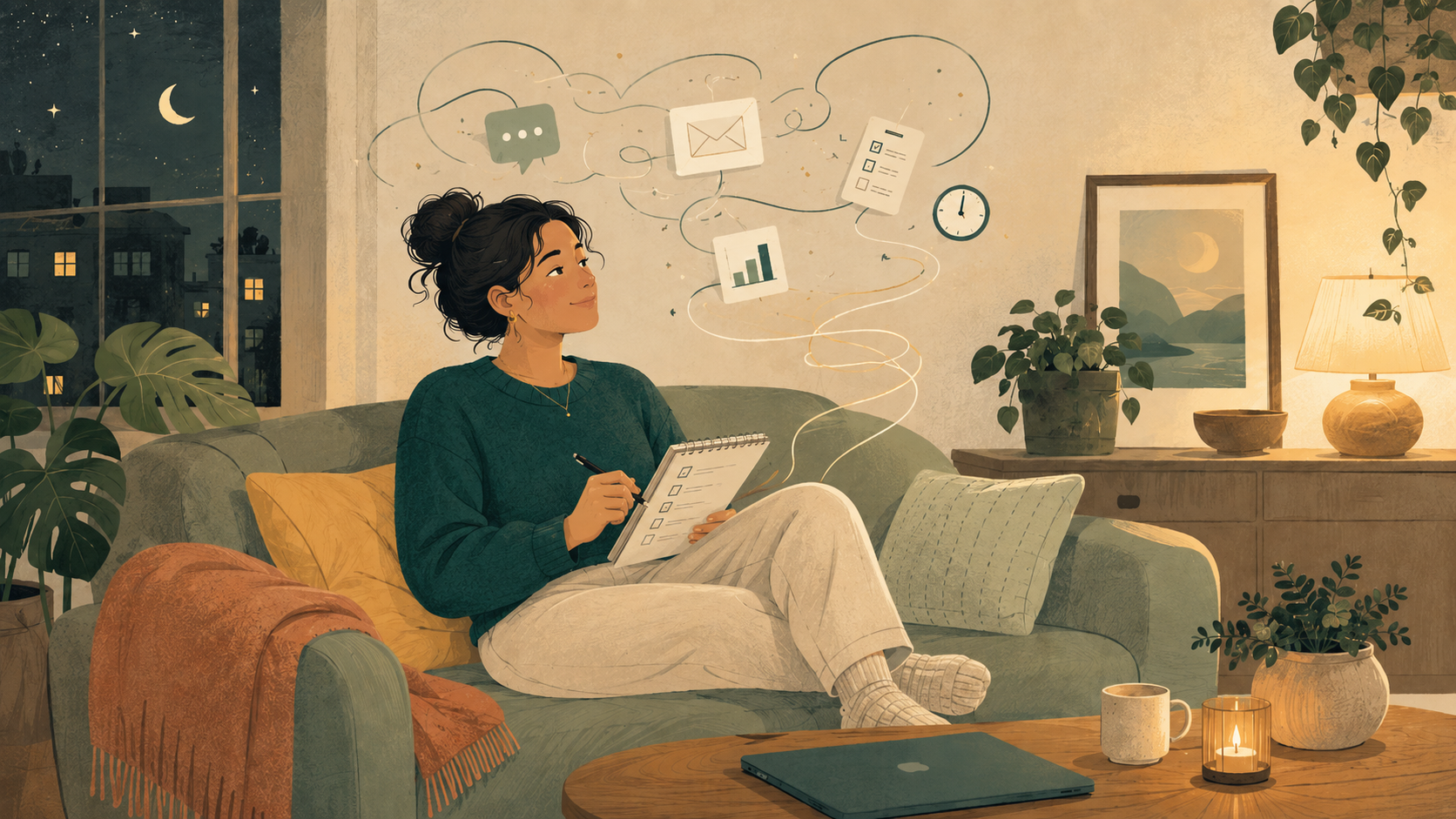
You closed the laptop at six. It's now nine-thirty, you're on the couch, and you are still drafting a reply to the message your director sent at 4:50. Nobody asked you to. You're not even worried about it, exactly. Your mind just won't switch off.
Most advice for this treats it as a willpower problem or an anxiety problem. It's usually neither. It's an unfinished-business problem, and that distinction changes what actually works.
What does it mean when your mind won't switch off?
A mind that won't switch off is one that keeps running work-related thought after work has ended. Researchers call the opposite of this psychological detachment: mentally disconnecting from work during non-work time, not just physically leaving it.
The physical part is easy to measure. You left the building, or you shut the laptop, or the last call ended. The mental part is separate, and it is the part that decides whether your evening is actually yours.
What this looks like in practice is rarely dramatic. It's rehearsing a conversation you already had. It's opening the fridge and realizing you've been mentally rewriting a slide for four minutes. It's lying down at eleven and finding that the horizontal position is apparently when your brain files its report.
You can be perfectly calm and still not be detached. That combination confuses people, because it doesn't match what they expect stress to feel like.
Why does work follow you home?
Unfinished tasks have a way of staying with you. Psychologists have studied this for about a century, and it means the thing pulling at your attention at nine-thirty isn't a character flaw. It's an open loop.
The best-known version is the Zeigarnik effect, the idea that we remember unfinished tasks better than finished ones. That part hasn't held up consistently. A related finding has: people are strongly inclined to go back to things they left incomplete. And in a study of employees, unfinished work at the end of the week was linked to more rumination and poorer sleep over the weekend.
Here is the part that's actually useful. In 2011, psychologists E.J. Masicampo and Roy Baumeister tested whether the loop has to stay open until the task is done. It doesn't. Across five studies, people carrying an unfulfilled goal showed more intrusive thoughts during unrelated reading, worse performance on unrelated puzzles, and higher mental accessibility of goal-related words. When participants were allowed to write a specific plan for that unfinished goal, those effects disappeared, without the goal being completed.
Having a clear plan can make unfinished work easier to set aside. These were lab studies, but a later study of 103 employees found something similar in everyday life: planning how to finish unfinished goals helped people detach in the evening.
So the mind isn't demanding that you finish the thing tonight. It's asking to know when and how the thing gets handled. Those are different requests, and only one of them is answerable at nine-thirty on a Tuesday.
Is this anxiety, or is it something else?
Not necessarily. Difficulty detaching from work is extremely common among people with no anxiety condition at all. But racing thoughts can also be a feature of anxiety, and the two can look similar from the inside.
A few things tend to separate them, though none of this is a diagnosis and none of it replaces a conversation with a professional.
Work rumination usually has a subject. It's about the deadline, the conversation, the thing you forgot to send. It tends to loosen when the work situation resolves, and it tends to be worst on the days the work was heaviest.
Anxiety more often generalizes. It moves from topic to topic, it shows up on days that gave it no obvious material, and it frequently arrives with physical company: a tight chest, a fast heart rate, a sense of dread that isn't attached to anything specific.
If your thoughts race on quiet weeks as readily as busy ones, if they're accompanied by persistent physical symptoms, or if they're interfering with sleep most nights over a long stretch, that's worth raising with a doctor or therapist. That isn't an escalation. It's just the right person for that particular question.
Why doesn't "just relax" work?
Because relaxation and detachment are two different things, and only one of them addresses the loop. You can be physically relaxed on the couch while your mind is still fully at work, which is exactly the state most people are in when the advice fails them.
Sonnentag and Fritz mapped this in 2007 when they built the Recovery Experience Questionnaire. They identified four distinct off-hours experiences that predict how well someone recovers: psychological detachment, relaxation, mastery, and control. Four separate things. Getting one does not get you the others.
This is why the standard evening advice underperforms. A bath, a glass of wine, a scroll through your phone: those are relaxation attempts. They lower physical arousal. They do nothing about an open loop, and a couple of them actively feed it, because a low-demand activity leaves plenty of spare attention for rehearsing the workday.
Detachment has been the most-studied of the four for a reason. Research links it with lower burnout and fatigue and better sleep quality. It also tends to matter most for the people who need it most: the more demanding the job, the more the evening depends on detaching, and the harder detaching becomes.
That last point is worth sitting with, because it explains something that otherwise feels like a personal failing. The days you most need to switch off are the days you'll find it hardest. That's the shape of the problem, not evidence that you're bad at it.
Why is it harder when you work from home?
Because the commute was doing more work than anyone gave it credit for. It was a physical marker, a block of time with no work in it, and a change of setting: three detachment cues bundled into one unavoidable habit. Remove it and nothing replaces it by default.
Working from home removes the boundary in both directions. There's no moment where the building ends. The desk is eleven feet from the couch, and the laptop is still on it. If you've ever finished at six and felt like you never quite left, that's not imagination: the signal that used to say the day is over has been deleted and nothing was assigned to the role.
There's a second thing that happens with hybrid and remote work: the day fragments. A morning of calls with fifteen-minute gaps produces a lot of half-finished items, and half-finished is exactly the state that stays mentally active. You end the day with more open loops than an equivalent day in an office would have produced, and fewer cues telling you to close them.
The fix isn't to recreate a commute. It's to notice that a role went unfilled and to fill it deliberately, which is most of what the next section is about.
What actually helps you detach?
The approaches with the most support behind them share a feature: they close the loop rather than trying to drown it out. Instead of distracting yourself from the open item, you give your brain the plan it's been asking for.
Write the specific plan, not the list. This is the Masicampo and Baumeister finding, applied. A list of what's outstanding tends to make the evening worse; you've just enumerated every open loop without resolving any. A plan is different: the item, when you'll do it, and the first concrete move. Not "finish the deck." Instead: "Tuesday 9am, open the deck, rewrite slide 4 first." Three lines is usually enough. The point isn't organization. It's telling your brain the thing is handled so it can stand down.
Give the transition a physical marker. A boundary your body can detect works better than one that exists only as an intention. Closing the laptop and putting it in a drawer. The walk around the block you take before you come inside. Changing out of the clothes you worked in. The specific action matters less than the fact that it's the same one every day and it means one thing.
Take back a decision. Control is one of the four recovery experiences, and it's the one most people forget. After a day where everything was assigned to you, choosing something genuinely for yourself (even something small, even for ten minutes) restores a sense of authorship the workday spent. What you choose matters less than that you chose it.
Use something that occupies attention. Detachment holds better when the alternative activity actually asks something of you. Cooking a real dinner, an instrument, a conversation that requires listening, a walk without headphones. Passive scrolling leaves too much attention free, and free attention returns to the open loop.
Where to start tonight
You don't need all four. If you try one thing, start with a plan.
Before you finish work, write down the task most likely to follow you home, when you'll return to it, and the first step you'll take. Then close the workday in a way you can repeat.
Some evenings your mind will still be busy, especially after a demanding day. That doesn't mean you did it wrong. The point isn't to force yourself to relax. It's to give unfinished work somewhere to land.
If you'd like a fuller version, our guide to how to stop thinking about work after hours walks through a fifteen-minute routine: close, cross, downshift.
Vara is being built to support evenings like these with short practices sized to real life. See how Vara works.
Vara is a wellness tool, not a medical device or a replacement for therapy. If racing thoughts are affecting your sleep or daily life, consider speaking with a healthcare professional.
